It's the night before your affiliate payout run, and the top thread in your inbox is titled "Re: Re: W-9?" Two partners still owe you a form. One of them, in Lisbon, wants to know which one is "the foreign one", and the payout file can't go until you've answered.
Most of the fix is timing. Move W-9 and W-8BEN collection out of payout week: ask when a partner joins, and hold only their first cash payout until the form is on record. Then note when each W-8BEN runs out, and file each form with the payouts it covers. RefRef publishes this blog and is the worked example near the end, but the steps don't depend on any one tool.
The form rules come from IRS pages, checked November 10, 2026. This isn't tax advice: it's the operating side of the forms, and your accountant still owns the tax side. If you're still choosing a program type, read referral vs. affiliate programs first.
Which tax form does each affiliate need?
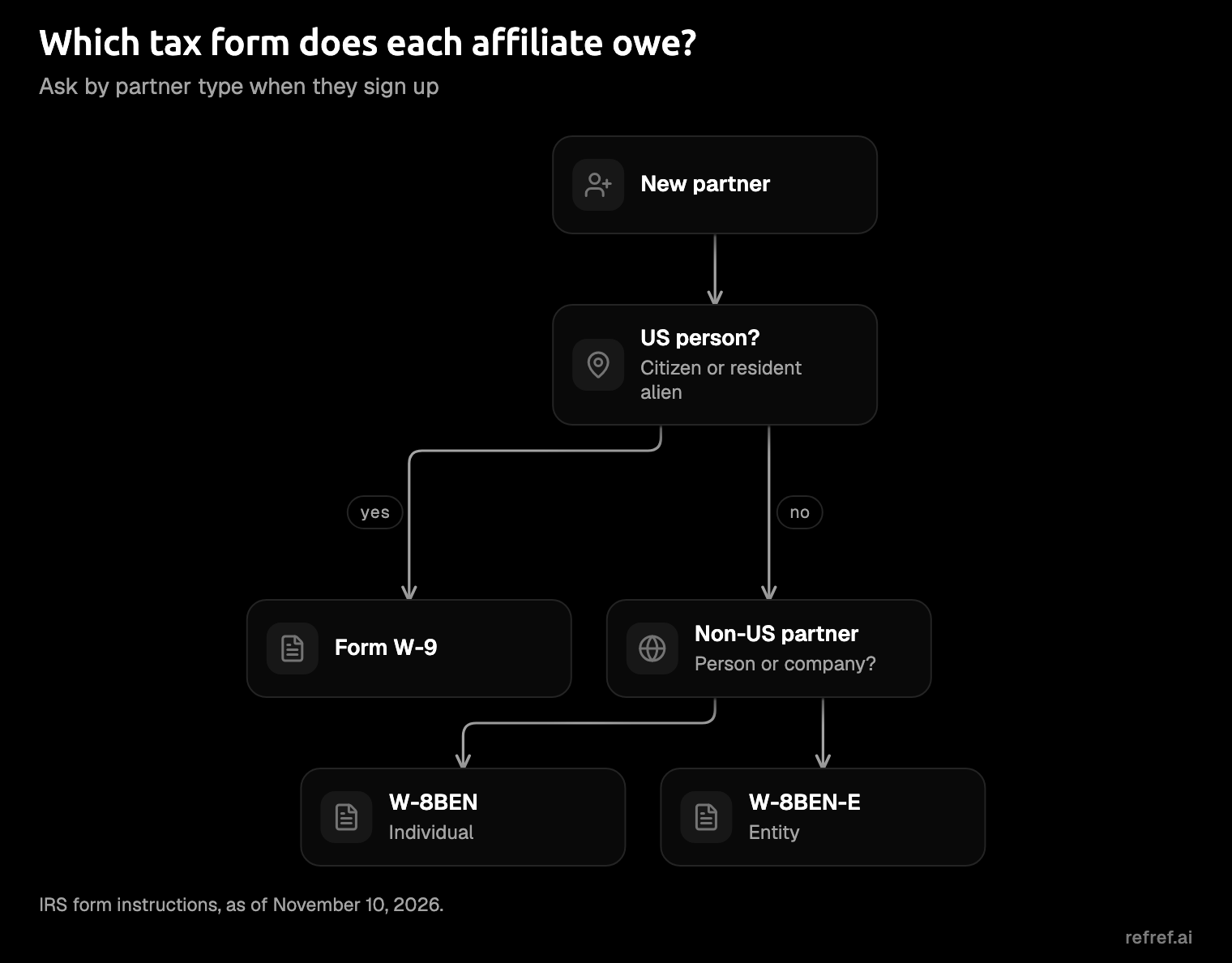
The form depends on who the partner is for US tax purposes, not where they live or how you pay them. The IRS instructions split your affiliates three ways:
- W-9 for US persons, including US citizens and resident aliens (W-9 instructions). Send partners the current revision, from March 2024.
- W-8BEN for individuals who aren't US persons (W-8BEN instructions).
- W-8BEN-E for foreign entities, such as an agency or a company. The W-8BEN instructions tell entities to use the W-8BEN-E instead (W-8BEN-E instructions).
There's no shortcut for foreign partners. A foreign person can't hand you a W-9 to keep things simple: the W-9 instructions say foreign persons may not provide one and use the appropriate W-8 or Form 8233 instead.
The forms come to you, not the IRS. The W-8BEN instructions put it bluntly: "Do not send Form W-8BEN to the IRS." For the W-9, the instructions describe you, the requester, putting the partner's name and taxpayer identification number (TIN) on the information returns you file.
Ask by partner type at sign-up, and never send everyone both forms. One question does most of the work: "Are you a US person, and are you joining as an individual or a company?" The answer picks the form, and it's the split the IRS suggests too: a W-9 for US recipients, the appropriate W-8 for foreign ones.
Skip that question and you meet the London agency that fills out a W-8BEN because it's the foreign form everyone mentions. It arrives promptly, signed and wrong. As a company, the agency owed you a W-8BEN-E.
When to ask: at onboarding, not at payout
The payout run is the worst time to ask for a tax form. The partner has earnings waiting, you have a deadline, and suddenly you're the one standing between them and their money. Every late form turns into a thread of reminders that neither of you enjoys.
Ask when they join instead, before any earnings exist. At that point the form is one more onboarding step, like choosing a payout method, and nobody's money is waiting on it. To be clear, that's our recommendation, not an IRS rule: the IRS pages say which form to ask for, not when.
Tolt's guide to paying affiliates points the same way: collect forms "before the first payout, or at minimum before year-end." Onboarding gets you there sooner, and without the deadline.
The order also changes how the request feels. A partner who sees "complete your tax form" on day one treats it as setup. The same partner who sees it next to their first commission reads it as the reason they aren't getting paid.
Whatever tool you use, put the request in the welcome sequence, not the payout reminder.
Why the first cash payout is the gate
Asking early doesn't guarantee an answer, so you also need a rule for when the form isn't there. The IRS supplies the reason. When a US partner doesn't give you a TIN, reportable payments to them are subject to backup withholding at 24%, and you withhold until the TIN arrives.
There's no grace period to lean on, either. The W-9's 60-day "Applied For" window covers interest and dividends, while nonemployee compensation is subject to backup withholding right away. Backup withholding follows the 1099-NEC threshold, so it applies once a partner's total for the year reaches that line (see the year-end check).
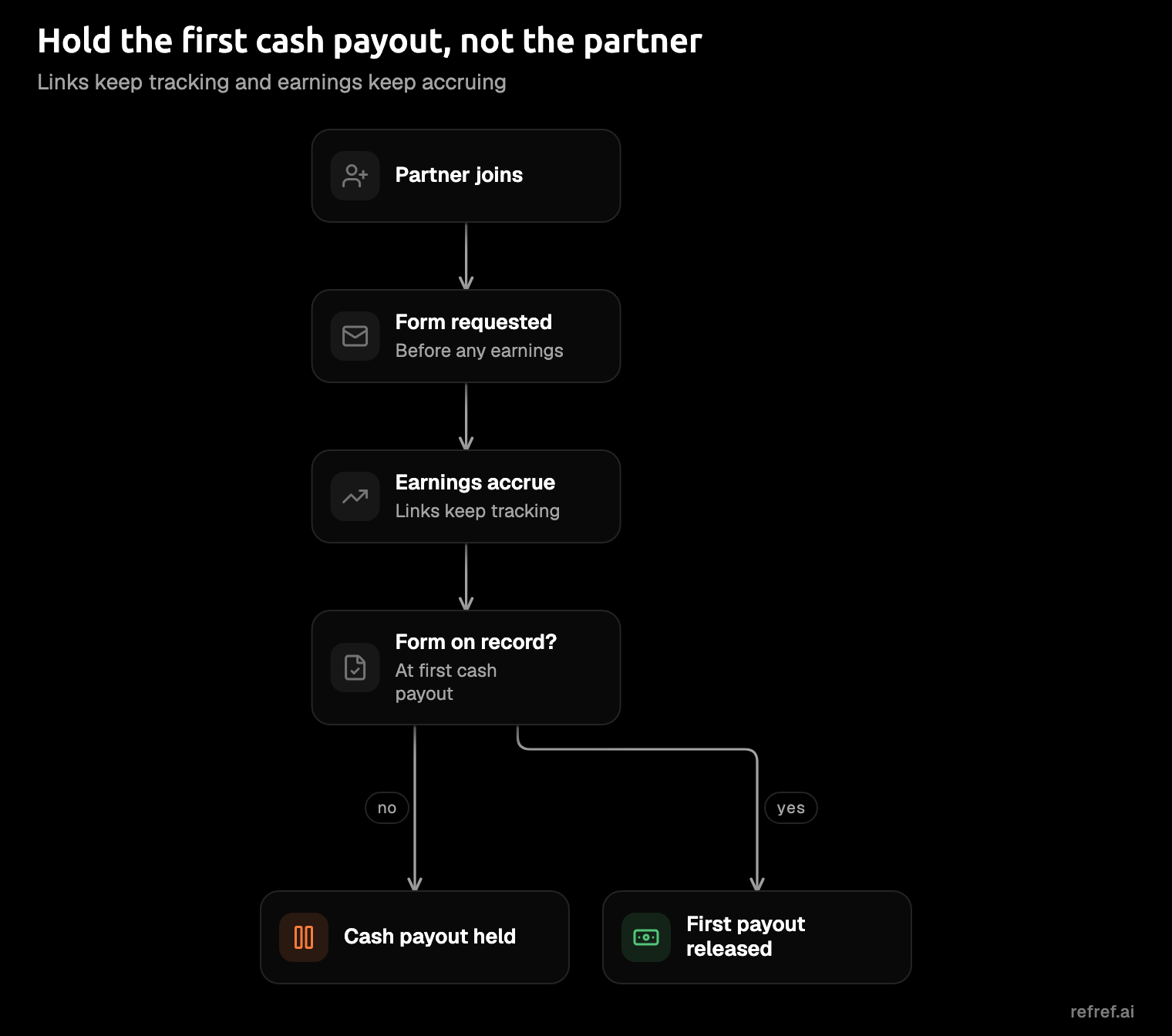
So the clean rule is short. Earnings accrue, links keep tracking, and the first cash payout waits until the form is on record. Once it's in, later payouts go out as normal until the form expires or something changes.
Hold the money, not the partner.
Don't pause their links or lock them out of their dashboard. A partner watching commissions pile up behind one unfinished form has the best reason there is to finish it.
RefRef builds this gate in: a partner's first Live cash payout waits for the form. The RefRef section near the end has the rest of its workflow.
How long each form lasts
A W-8BEN has an end date. A W-9, going by its instructions, doesn't, but it can still go stale.
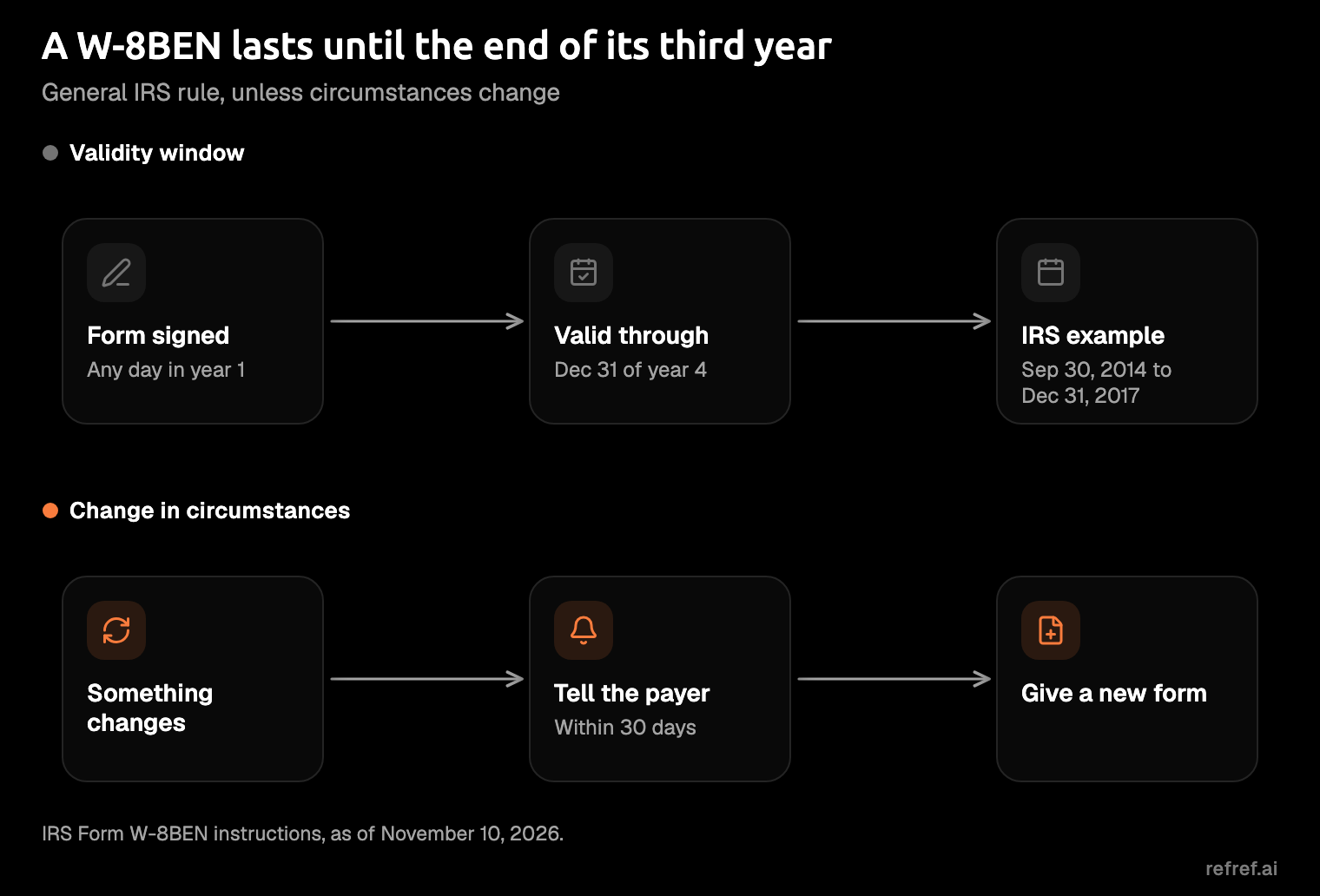
The W-8BEN and W-8BEN-E generally stay valid from signing through the last day of the third calendar year after the year of signing. The W-8BEN-E instructions give an example: a form signed September 30, 2014 stays valid through December 31, 2017. Under certain conditions a form can stay valid indefinitely, but for planning, the three-year window is the one to watch.
A change in circumstances ends a W-8 sooner. The partner should tell you within 30 days and give you a new form, and one who becomes a US citizen or resident alien may owe you a W-9 instead.
The W-9 instructions give no expiry date for the form itself. That isn't the same as "valid forever". A W-9 stops counting once you know, or have reason to know, that the partner's circumstances changed, and an address marked "NEW" on the form is your cue to update your records.
Write the expiry date on the partner record the day a W-8 arrives. Then ask for a fresh one in the autumn before it lapses, while the partner still has payouts coming and a reason to answer.
Skip that and you'll meet the partner whose W-8BEN quietly ran out on New Year's Eve. You'll find out during the first payout run of the year, which is exactly where this guide started.
Where to keep the forms
Keep each form next to the payout records it justifies. When someone asks why a partner was paid in full with nothing withheld, the answer should sit one click from the payout, not at the bottom of an inbox search.
The inbox is a fine place to receive a form and a terrible place to keep one.
The IRS sets a few rules for you as the requester:
- Keep the information on a W-9 confidential.
- Collect W-9s electronically and you need an audit trail: proof that what you received matches what was sent, a record of the access behind each submission, and an electronic signature under penalties of perjury when one is required (W-9 instructions).
- If the IRS asks, you have to supply a hard copy of an electronically submitted W-9.
- The privacy and paperwork notice on the form instructions adds that records must be kept "as long as their contents may become material in the administration of any Internal Revenue law."
The IRS pages give no separate retention period for W-9 or W-8 forms. The general instructions for information returns set one for the returns themselves: four years if backup withholding was imposed, otherwise at least three. How long to hold the forms is a fair question for your accountant.
Our rule of thumb is one record per partner: the form, the date it arrived, its expiry date, and every payout made against it. Then any question about that partner, from your accountant or from the partner, starts and ends in one place.
The year-end check
If onboarding did its job, year end is a list, not a scramble. Run two of them each December.
First, list the US partners whose payments for the year are near the 1099-NEC threshold. For payments made after December 31, 2025, the IRS puts it at $2,000, up from $600. Some guides, and at least one undated vendor help page, quote the old figure. The IRS instructions also say the threshold may be adjusted for inflation from 2027.
Second, list the W-8BENs and W-8BEN-Es whose third year ends this December. Ask those partners for a fresh form now, before January's first payout.
Filing the returns is its own job, and it's outside this guide. The 1099-NEC goes to the IRS and to the payee by January 31, and the IRS instructions for Forms 1099-MISC and 1099-NEC cover the rest.
Which partners need an information return, and which form, is your accountant's call. Your two lists just make it a short conversation.
How affiliate tools handle tax forms
Most affiliate tools say they collect W-9s and W-8s. Fewer say what a missing form does to a payout, and that's the part that decides whether you're chasing forms in payout week. This is what each official page says as of November 10, 2026; a tool may do more than its page shows.
| Tool | Forms collected | Payout held until the form is in? |
|---|---|---|
| RefRef | W-9 and W-8BEN, on record | Yes: a partner's first Live cash payout waits for the form |
| Tolt | W-9 and W-8 on every plan | Pricing page says "Collected before a partner's first payout"; its guide's example reads "No form, no payout", but as an example, not a stated policy |
| Dub Partners | W-9 for US partners, W-8 for non-US partners; W-8BEN not named | Not stated; payouts stay pending without a payout method or below the minimum |
| FirstPromoter | W-9 and W-8BEN, uploaded by affiliates; collection is off by default | Not stated; payouts can be filtered by "Has W8/W9 form" |
| PartnerStack | W-9 and W-8 for partners who withdraw by direct deposit | Its support page says direct-deposit partners submit a form to get paid; Stripe and PayPal withdrawals aren't prompted for one |
| GrowSurf | "Tax Forms & 1099 Filing" from the Startup plan; W-9 and W-8BEN not named | Not stated |
| Rewardful | No tax forms on the pricing page | Not stated |
Our compare pages go further on Tolt, Dub Partners, FirstPromoter, PartnerStack, and GrowSurf.
"Handled" on a pricing page isn't a workflow. A checkmark next to "W-9/W-8" tells you the form lives somewhere in the product, not whether you'll be emailing partners about it the night before a payout run. Before you pick a tool, get answers on these:
- Check when it requests the form: when the partner joins, or when money is due?
- Find out what a missing form blocks: nothing, every payout, or only the first.
- Confirm whether it tracks W-8BEN expiry, or whether that's your calendar's job.
The workflow in RefRef
RefRef publishes this blog, so read this section with that in mind. It's also the most direct example of the workflow above, because the gate lives in the product, not on a sticky note by your monitor.
- The request. RefRef emails partners about their tax form, so the ask doesn't depend on you remembering to send it.
- The sign-up question. Partners can apply through a public join page with your own application questions, so the "US person, individual or company?" question from the first section can sit right there.
- The payout. Managed cash payouts through PayPal start on the Starter plan, and Stripe Connect payouts are available too.
- The code. RefRef is open source under AGPLv3. Use RefRef Cloud, or self-host it on your own servers.
The partner docs walk through the setup. To see the flow end to end, start free on RefRef Cloud, where the free plan has no time limit. Set up one affiliate program in a Project's Sandbox and send a test referral through it before you invite your first real partner.
FAQ
How long is a W-8BEN valid?
Generally through the last day of the third calendar year after the year it's signed, so a form signed September 30, 2014 was valid through December 31, 2017. A change in circumstances ends it sooner.
Can a non-US affiliate fill out a W-9?
No. The W-9 instructions say foreign persons may not provide one; they give you the appropriate W-8 or Form 8233 instead.
What if an affiliate never sends the form?
Hold the cash payout and keep asking. Without a TIN, reportable payments to a US partner are subject to backup withholding at 24% until one is furnished, which is worse for everyone than a polite reminder. For a foreign partner with no W-8, or anyone genuinely stuck, take it to your tax adviser, not your inbox.
Do I send the W-9 to the IRS?
No, you keep it. The W-8BEN instructions say not to send that form to the IRS, and the W-9 instructions describe you using the partner's details on the information returns you file.