Somebody in a founders' chat asks what commission you should pay affiliates. Ten replies arrive within the hour: a different percentage in each, two votes for "lifetime", a link to a thread from years ago, and no math at all.
If you're about to start a SaaS affiliate program, this guide gives you the six decisions in launch order, each with a sourced default, plus a worked margin model you can rerun with your own numbers. RefRef publishes this blog and makes affiliate software, so it's the worked example at each step. The defaults hold whichever tool you choose.
The rate turns out to be the easy part. The refund hold, the tax form and the payout date are where programs quietly turn into a spreadsheet tab called affiliates_FINAL_v3.
The short version: a launch checklist
Start with defaults you can defend, then change one at a time, so that when sign-ups move you know which change did it.
- Pay 20 to 30% recurring, for 12 months.
- Credit a partner for a purchase up to 90 days after their click.
- Find your refund window first, then hold each commission for at least that long (Rewardful and Dub both default to 30 days).
- Use a short application, about four questions plus a URL, and auto-approve only the obvious cases.
- Set two or three tiers on referred revenue.
- Collect the W-9 or W-8BEN at approval, then pay monthly once the hold clears.
None of these is a law. Each is a starting point a partner will recognize and your accountant won't wince at.
Step 1: Choose the commission model
Commission has two parts: the rate, and how long you pay it. Choose both from your margin, not from the loudest reply in the chat.
What's a normal SaaS affiliate commission?
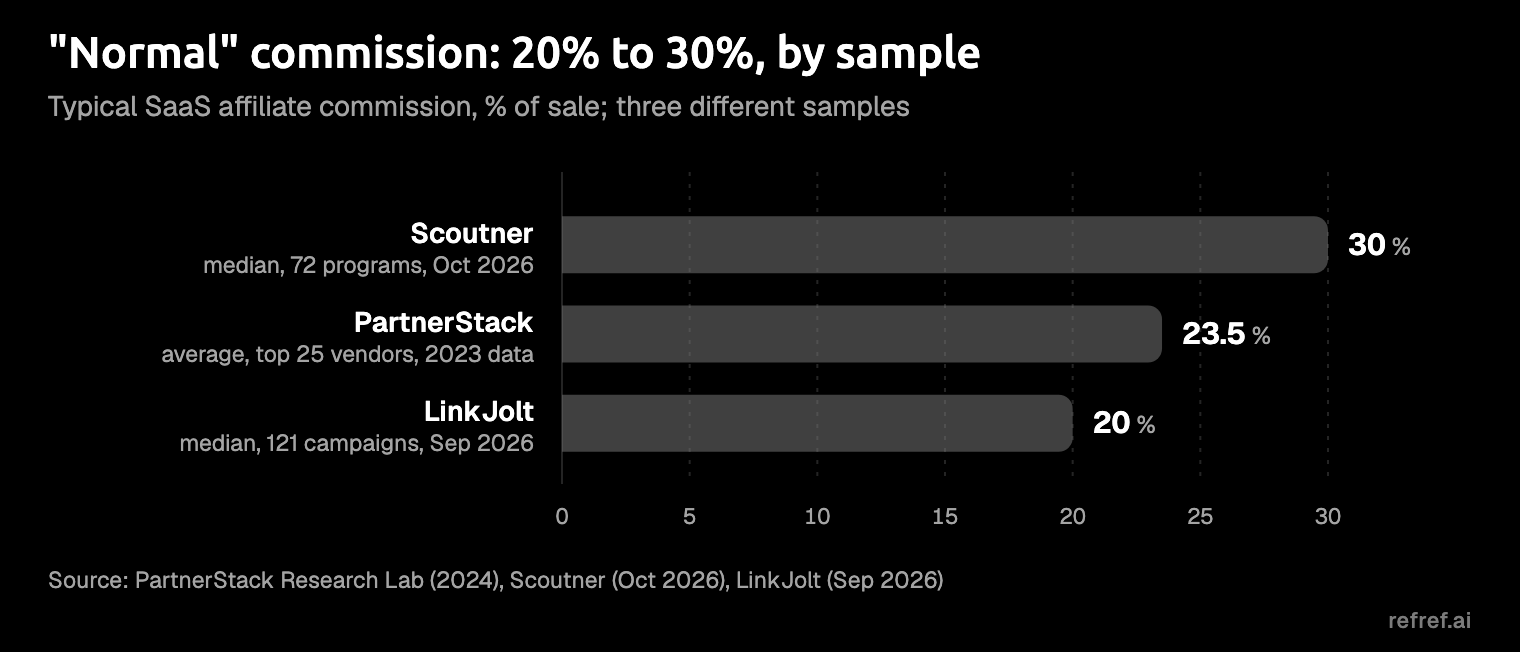
There's no single normal rate, because each published figure measures a different set of programs. Three measured samples are worth knowing, and they don't agree:
- PartnerStack's top 25 vendors averaged 23.5% in 2023 data, published in March 2024, and the best-performing offers clustered at 20%, 25% and 30%.
- Scoutner checked 93 SaaS affiliate programs in late September and early October 2026 and found a median of 30% across the 72 that pay a percentage.
- LinkJolt's snapshot of 121 campaigns on its own platform put the median at 20% and the average at 22.9%.
The spread comes from who's in each sample. PartnerStack looks at its highest-performing vendors, Scoutner at public programs that publish their terms, and LinkJolt at campaigns on its own platform, only 26% of which pay recurring commission. A median is only as normal as the programs behind it.
Vendor guides land in the same range, though they're advice rather than measured data. Tolt suggests starting at 25 to 30% recurring for 12 months, Reditus says established companies often pay 20 to 30% for 12 to 24 months, and PromoteKit puts the typical range at 15 to 30%.
So quote partners a rate in the 20 to 30% recurring band. Where you land inside it depends on your margin, which no competitor's pricing page can tell you.
Recurring, one-time or flat
Most SaaS programs pay recurring commission, and most of those stop after a year. In Scoutner's sample, 60% pay recurring, 19% a flat bounty, 12% one-time and 9% tiered; of the recurring programs, 54% pay for 12 months and 29% for the customer's lifetime. The 12-month programs pay a median 25%, the lifetime ones 30%.
Each model suits a different product:
- Recurring for a set period fits subscriptions. The partner earns while the customer pays, up to the limit you set.
- A flat bounty fits a free trial or a low-priced plan, where a percentage of a small invoice isn't worth a partner's effort.
- Lifetime fits only if you can afford the payment for as long as the customer stays, which is a long time to be sure of anything.
Your tool should support all three. As of November 10, 2026, Dub's help pages, for one, list one-time, three months to three years, or lifetime rewards on sales, as a percentage or a flat amount.
Launch with 12 months, not lifetime. You can always extend a duration later. Taking one away costs you your best partners, and you'll hear about it for years from the one who still emails about a lifetime deal from 2021.
A worked margin model (hypothetical)
Reditus sizes the cost of one referred customer as monthly ARPA (average revenue per account) times the commission rate times the months you pay. Reditus's formula stops there. Two lines are missing: the payout fee on every commission, and the commission you lose on a refunded first payment if you paid before the refund window closed.
Take a made-up plan and run three offers through it. Every number in this block except the payout fee rates is hypothetical, picked to look like a small B2B tool, not taken from a customer or a benchmark.
Hypothetical plan: $80 a month, 80% gross margin, customers stay 24 months on average,
5% of first payments refunded, paid CAC (cost to win a customer through ads) $500
Gross profit per customer over 24 months: $1,536

Cost per referred customer         30% for 12 months   20% lifetime   $150 flat bounty
Commission (ARPA x rate x months)            $288.00        $384.00            $150.00
Payout fee at 2%                               $5.76          $7.68              $3.00
Total, paid after a hold                     $293.76        $391.68            $153.00
Same total at a 5% payout fee                $302.40        $403.20            $157.50
Extra loss if you pay before refunds           $1.20          $0.80              $7.50
Share of the $500 paid CAC                       59%            78%                31%
Share of the $1,536 gross profit                 19%            26%                10%
The fee lines use RefRef's managed payout rate of 2% and Dub's ACH rate of 5%. For the sanity check, PromoteKit suggests keeping what you pay affiliates per customer at roughly 50 to 80% of your paid CAC.
Read the columns left to right. The year-long offer sits comfortably inside that band, and its cost has a ceiling: a customer who stays for years costs you the same as one who stays a year and a day. The lifetime offer lands near the top of the band for an average customer, then keeps climbing for everyone who outstays the average, who are exactly the customers you most want. The flat bounty sits below the band: the cheapest offer, and the most exposed to refunds, because the whole amount goes out at once.
No paid CAC yet? The last row is for you. It shows what share of a customer's profit each offer hands to the partner, so you can decide how much of it you'd give away for a customer you didn't have to find yourself.
Set the rate from your margin and your paid CAC, then round it to a number partners recognize. You can rerun the block with your own inputs in the referral ROI calculator. If you're weighing cash against account credit, how to choose referral rewards works through why they cost you differently.
In RefRef
You create an Affiliate program and give it a reward rule: a percentage of each purchase, paid for a fixed period. The docs' own affiliate template is the launch default, "20% cash on each purchase for 12 months". Rewards can also run one-time or for the customer's lifetime, with caps if you want them. Percentage amounts apply to purchase rules. The programs and rewards docs cover each field.
Step 2: Set the attribution window and refund hold
Two settings decide whether a commission is fair: how long a click counts, and how long you wait before paying for it. Both belong in your program terms, where partners can read them.
How long should the cookie last?
The attribution window is how long after a partner's click a purchase still credits that partner. It usually lives in a cookie, so you'll also hear it called cookie length. Make it longer than your sales cycle: a buyer who clicks in March and signs in May should still count.
Scoutner's median published window is 90 days, across the 65 programs that publish one, and 28 of the 93 programs it checked publish nothing at all. Reditus calls 90 days the floor for a considered B2B purchase, and Tolt's guide suggests B2B programs start at 90 within a range of 60 to 180 days. As of November 10, 2026, Rewardful defaults to 60 days and lets you change it per campaign.
Whatever you pick, publish it. Nearly a third of programs don't, and partners comparing offers notice the blank.
Hold commissions until refunds can't happen
A hold, sometimes called a pending period, keeps a commission unpaid until the customer can no longer get their money back. Without one, you pay a commission on Tuesday for a customer who refunds on Thursday.
Rewardful's advice is to match the pending period to your refund policy, so a 90-day refund policy gets a 90-day hold; its default is 30 days, and refunds after a commission is paid aren't recovered. Dub offers holds from 0 to 90 days, defaults to 30 and advises against 0. Tolt's guide says to wait 30 to 60 days to cover refunds and chargebacks.
Set the hold to your refund window, never shorter.
How much the hold saves depends on the offer. The margin model counts only refunds of a first payment, so on the percentage offers its refund line is small; a real program also sees refunds and disputes on later payments, and a hold catches those only when they land inside it. A flat bounty goes out whole, so it's the offer a refund hurts most.
A partner will forgive a payout that arrives a few weeks later. Chasing a partner for money you've already sent is a conversation nobody wins.
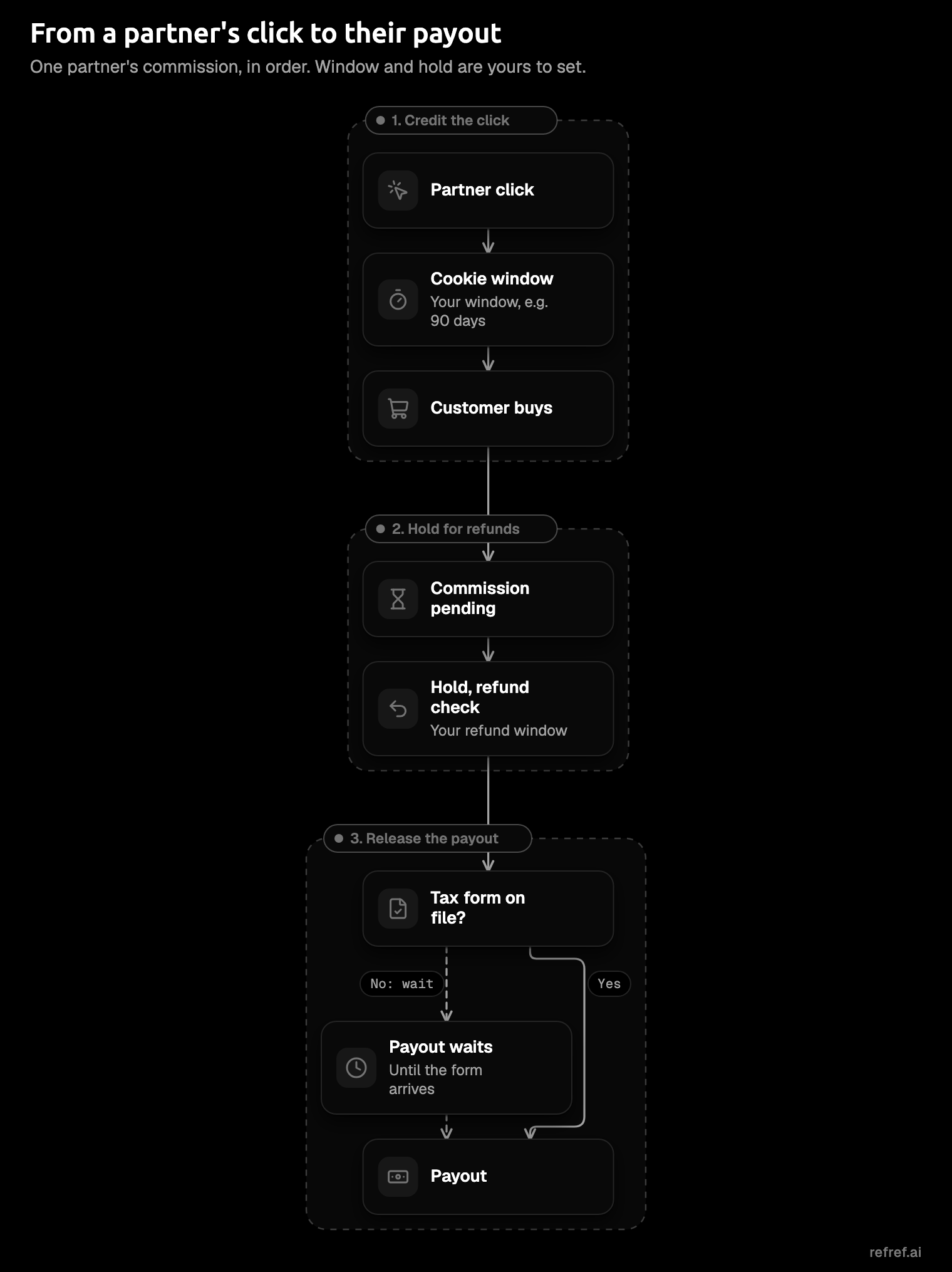
A generic flow, not a RefRef screen. The tax-form step shows how RefRef handles it; Step 5 covers how other tools differ.
In RefRef
Before you write a window and a hold into your terms, check that your tool can enforce them; for RefRef, the programs docs list each program's settings. When a refund comes in, RefRef adjusts the reward: a partial refund reduces it in proportion, and a full refund takes back a delivered non-cash reward. Voids are final, so void with care. If you void a reward after paying cash, the amount comes off the partner's next payouts, which works nicely right up until a partner stops earning. Hence the hold.
Step 3: Write the join page and application questions
What to ask (and what not to)
An affiliate application has one job: to tell you whether to say yes. Keep it short. Reditus suggests about four questions plus a URL, and long forms put off the good applicants, who have other programs to join. Dub always asks for name, email and country, which makes a sensible baseline.
The four questions we'd start with:
- Your website or main channel (a link, not a handle).
- Who your audience is, and roughly how big it is.
- How you plan to promote the product: content, a newsletter, video or client work.
- Whether you use the product yourself.
Every question should change an approve or decline decision. If no answer to it would change your mind, cut it.
Auto-approve rules
Auto-approve rules let the obvious yes through and turn away the obvious no, so you only read the middle. At launch, you probably don't have the volume to need them yet.
As of November 10, 2026, Dub never auto-approves applications its risk checks flag and advises against auto-approving every group, and Tolt's guide goes further: review every application by hand. Dub's default is a 30-day wait before a declined applicant can try again.
Read every application for the first few weeks, and write down why you said yes. Those reasons become your rules. The coupon site that applies with "Instagram: two million followers" and no link will teach you your first auto-decline rule faster than any template.
In RefRef
Each affiliate program gets a public join page at partners.refref.ai/join/your-program, or you can invite partners by email. You turn on Accept applications in the program's settings, add up to 10 questions, and set auto-approve and auto-decline rules for the cases you've already decided. A Turnstile bot check and bans keep out the scripted and the persistent. When you decline someone, you choose whether they can reapply Immediately, After 30 days or Never. The partners docs walk through each setting.
Step 4: Set tiers that reward top partners
Tiers pay your best partners more, which matters because a few partners tend to do most of the work. Reditus says the top 20% of active affiliates produce 80 to 87% of monthly revenue, though it doesn't show the sample behind the figure. Yet only 9% of the programs Scoutner checked are classed as tiered.
Tier on referred revenue, not clicks or sign-ups. Clicks are the easiest number in the program to fake, and sign-ups don't pay your hosting bill.
A simple ladder uses the three rates partners already recognize, the 20%, 25% and 30% that PartnerStack found most common among high-performing offers. The revenue goals in this ladder are hypothetical; set yours from what your current best partners actually refer.
Hypothetical tiers (set the goals from your own partners' numbers)

Tier     Goal: referred revenue     Commission (recurring, 12 months)
Base     approved partner           20%
Growth   $2,000 a month             25%
Top      $8,000 a month             30%
Show each partner their own tier and next goal, not a public leaderboard. Reditus advises against leaderboards, and suggests tying some rewards to behavior rather than volume alone. A leaderboard mostly tells nine partners they're losing.
In RefRef
Tiers use goals on referred revenue or conversions, and partners move up automatically when they hit one. Each tier carries its own commission. You can also pin a partner to a tier, which is exactly what you need for the agency you promised the top rate before they'd sent a single customer. To test a different ladder, Duplicate Program copies the whole program so you can change one thing and compare.
Step 5: Pick payouts and collect tax forms first
Payout rails and what they cost
A payout rail is how the money reaches the partner: PayPal, Stripe Connect, a bank transfer through a service like Wise, or your own accounts payable. You can run the rail yourself and pay no tool fee, or let your affiliate tool send the money for a percentage.
Payout fees from each vendor's official page, as of November 10, 2026. Tolt's figure is from its live pricing page.
| Tool | Payout rails | Fee on payouts |
|---|---|---|
| RefRef | PayPal to partners in 98 countries, Stripe Connect; or your own rail, credit and discounts | 2% managed, from Starter; nothing extra on your own rail |
| Tolt | PayPal, Wise, bank, wire | 2% of the amount paid out, every plan |
| Rewardful | PayPal and Wise mass payouts on all plans, plus Managed Payouts | 3% for Managed Payouts |
| Dub Partners | ACH or card | 5% ACH, 8% card |
| FirstPromoter | PayPal, Wise, Stripe, crypto, bank | Managed auto payouts on Enterprise only |
The payout fee is part of the commission. Put it in the margin model, not in the tools budget, where it hides until someone multiplies it by a year of payouts.
One limit to know: on RefRef, managed cash payouts start on Starter, capped at $1,000 a month. Pro plans raise the cap as high as $50,000 a month, and Enterprise sets a custom volume. On every plan, the free one included, you can pay on your own rail or reward in credit and discounts at no extra cost. Pricing lists each plan's limit.
Schedule and minimum
Most programs pay monthly, once a commission has cleared its hold. Tolt's guide suggests monthly payouts on Net-30 or Net-60 terms with a threshold of $50 to $100, and Reditus suggests a threshold that pays a partner after two or three commissions. A minimum stops you sending a few cents to someone whose bank charges more than that to receive it.
Publish the payout date. "When do I get paid?" is otherwise an email you'll answer every month, from the same partners, in the same week.
W-9 and W-8BEN before the first payout
Reditus advises a W-9 from each partner based in the US, and a W-8BEN from individual partners outside it. This is general information, not tax advice, and your accountant has the final word on what you file.
The IRS describes the W-9 as the form that gives you a person's taxpayer identification number, so you can file information returns. The W-8BEN is a foreign individual's certificate of foreign status, given to the payer. For US partners, the reporting threshold for Form 1099-NEC is $2,000 for payments made in 2026, up from $600 before, and it may be adjusted for inflation from 2027.
Ask for the form at approval, not at payout, as Reditus also advises. A partner chasing their first payment is the worst moment to send them paperwork. And the December week you'd otherwise spend emailing partners for tax IDs is better spent almost anywhere else.
Tools differ in how much of this they do. Tolt collects W-9 and W-8 forms before the first payout and files 1099s on every plan; FirstPromoter collects W-9 and W-8BEN forms on every plan; Dub collects the forms and sends 1099-NEC forms.
RefRef keeps W-9 and W-8BEN forms on record and holds a partner's first Live cash payout until the form is in; filing the 1099-NEC stays with you or your accountant.
Step 6: Launch to your first ten partners
Launch to a small group you've picked by hand, not to an open join page. Tolt's guide puts it bluntly: 10 active affiliates beat 100 dormant sign-ups.
Start with the people most likely to send buyers rather than traffic:
- Customers who already recommend you, in reviews, communities or your support inbox.
- Newsletter writers and agencies in your niche.
- Integration partners whose customers need what you do.
Invite them by email, and give each one a partner kit: their tracked link, a few lines of copy they can adapt, screenshots, and a short description of who the product is for. Rewardful's write-up of an r/SaaS analysis of 50 programs lands on the same advice: recruit directly, and favor quality over volume.
Then set expectations, for them and for you. Reditus says the first paid referral typically takes 3 to 6 months, and break-even 9 to 12. A quiet first month is normal, not a verdict.
In RefRef, you invite partners by email, and each one gets the Partner app: tracked links with clicks and QR codes, their referrals, rewards and payout history, and a resources library to hold the kit. Before you invite anyone, send one test referral through the Sandbox Project from click to commission. Each Project is a Live and Sandbox pair with its own participants, events and programs, so the test stays out of your real numbers.
Ten partners you talk to beat a join page nobody reads. Open the page once you know what a good applicant looks like.
Where RefRef fits
RefRef publishes this blog, so weigh the pick accordingly. We'd still choose it, for two reasons. First, most of this guide lives in one tool: the join page and its rules, the tiers, refund handling, payouts and the tax-form gate. Second, it's open source under AGPLv3, which none of the other affiliate products compared here is; as of November 2026, it's the only open-source platform we know of that runs referral, affiliate and loyalty programs together. Use RefRef Cloud, or self-host it on your own servers (docs).
The free plan covers up to 1,000 monthly active participants with no time limit, paid plans start at $49 a month ($29 billed yearly), and there's no share of referred revenue. Tolt starts at $99 a month, and Rewardful and FirstPromoter at $49, each with a 14-day trial.
From each vendor's official pricing, help or guide pages, as of November 10, 2026. "Lists none" means that page doesn't mention it, not that the tool can't do it. Fuller comparisons: Tolt, Rewardful, FirstPromoter, Dub.
| Applications and auto-approve | Tax forms | Open source | |
|---|---|---|---|
| RefRef | Public join page, up to 10 questions, auto-approve and auto-decline rules | W-9 and W-8BEN on record; first Live cash payout waits for the form | Yes, AGPLv3 |
| Tolt | Its guide advises reviewing every application by hand; its pricing page lists no application settings | W-9 and W-8 collected before the first payout; files 1099s | No |
| Rewardful | Pricing page lists none | Pricing page lists none | No |
| FirstPromoter | Manual approval thresholds, invite-only campaigns | W-9 and W-8BEN on every plan | No |
| Dub Partners | Custom form on Business and above; auto-approve per group | W-9 and W-8; sends 1099-NEC | Partner code removed from its public repo |
One limit the table doesn't show: RefRef is a younger product with a smaller community than Dub or Rewardful. The answer is code you can read before you commit, a free plan to try it on a real program, and no lock-in, since your participants, referrals, rewards and payouts are available through the REST API and signed webhooks if it doesn't fit.
When you want customer referrals or a loyalty program next to the affiliate one, they run on the same integration and the same customer record. Referral vs affiliate programs covers when you'd want each, and RefRef for B2B SaaS shows the fuller setup.
The point of a tool is that affiliates_FINAL_v3 never needs to exist.
FAQ
How much commission should a SaaS affiliate program pay?
The medians and averages in the measured samples run from 20 to 30%, and in Scoutner's sample 12 months is the most common duration for recurring programs. Pick your point inside that band from your margin and paid CAC, as in the model in Step 1.
How do partner program tiers and commission work?
Partners move to a higher commission when they hit a goal, best set on referred revenue. Two or three tiers are enough to start, at rates partners recognize, such as 20%, 25% and 30% (Step 4).
What should an affiliate application form ask?
About four questions plus a URL: the applicant's site or channel, their audience, how they'll promote you and whether they use the product (Step 3). Cut any question whose answer wouldn't change your decision.
Do affiliates need to fill out a W-9?
A W-9 gives you a US partner's taxpayer identification number so you can file information returns, and a W-8BEN is how a foreign individual certifies foreign status. For payments made in 2026, the 1099-NEC reporting threshold is $2,000. Ask for the form at approval, not at the first payout (Step 5).
Try it on one program
The cheapest way to test this plan is to build it once where mistakes cost nothing. Start free on RefRef Cloud; the free plan is enough for a test, since nothing gets paid out yet. Create one Affiliate program in the Sandbox Project with the checklist's defaults, then send a test referral through it from click to commission. If any of the six decisions doesn't hold up, you'll find out before a partner does.