The double-sided referral program on your whiteboard says "Give $20, get $20," which is exactly what Replit pays in credits for each new paying customer. Then the questions start. Should the friend get more than the person sharing the link? Should both of them get it on day one? What stops the whole thing costing more than the customers it brings in? And someone always asks, "What does Dropbox do?"
This post collects sixteen live double-sided referral programs in five structures, with what each side gets, when it pays and the cap each page states. After the examples: how to pick a structure for the way you bill, and how to build it in RefRef.
One opinion before the examples: copy the structure, not the number. Your number comes from your margin, and the reward-sizing guide does that math. The structure, meaning what each side gets and when, is the part you can borrow from companies that have already shipped it in public.
What a double-sided referral program is (and the patterns worth copying)
A double-sided referral program rewards both people in a referral: the customer who shares a link and the friend who uses it, once the friend completes a qualifying action like signing up or paying. A single-sided program rewards only the referrer. That's the whole definition. The useful part is how real programs fill in each side, and two patterns show up often enough to copy.
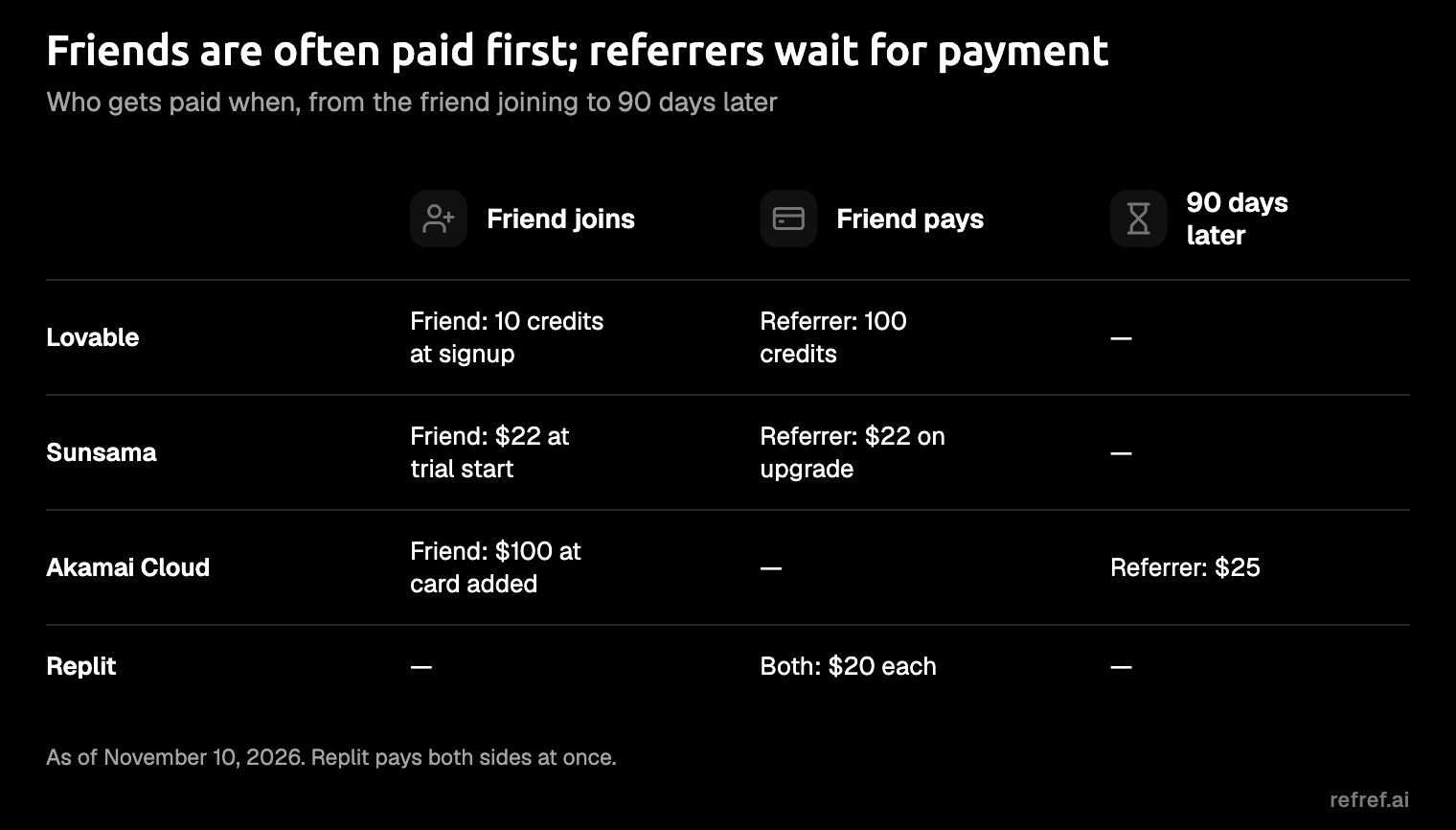
The friend often gets paid first; the referrer waits. In the programs that stagger their rewards, the friend's lands at signup or trial start, while the referrer's waits until money has changed hands. Sunsama issues the friend's credit when their trial starts and the referrer's when the friend upgrades. Lovable gives the friend 10 credits at signup but holds the referrer's 100 credits until the friend first pays. Akamai Cloud waits longest. The friend's $100 credit arrives when they add a payment method, and the referrer's $25 only after the friend has been active 90 days and spent $25. Replit is the counter-example, paying both sides their $20 in credits the moment the friend becomes a paying customer. Postmark, Setapp and Brex also reward both sides at a single event.
The two sides often differ. Lovable's referrer gets far more credits than the friend, and Akamai Cloud flips it, giving the friend the bigger number. Tally pays the referrer cash and gives the friend a discount. Many of the sixteen do give both sides the same amount, Replit, Proton, Vessi and Brex among them. A matching amount isn't a matching moment, though: Sunsama pays each side $22, at different points.
There's a reason for the split. The friend's reward is a conversion tool: it has to work before they've paid you anything, so it arrives early, as credit or a longer trial. The referrer's reward is a retention tool: it goes to someone who's already your customer, and it's safest paid once the friend has proved to be real. Size the two for those different jobs.
Pay the referrer at signup, and sooner or later you'll fund a reward for a friend who asks for a refund the next morning.
The five structures at a glance
Five structures cover all sixteen programs. They're grouped by what each side gets, because the type of reward, more than its size, decides what a program costs you and who it attracts.
| Structure | Programs | Referrer gets | Friend gets | Fits |
|---|---|---|---|---|
| Credit for credit | Replit, Sunsama, Proton, Akamai Cloud | Account credit | Account credit | Subscription and usage-billed SaaS |
| Product units | Dropbox, Lovable, Fathom | More storage, credits or paid time | Some of the same units, or a longer trial | AI apps and metered tools |
| Free months | Backblaze, Postmark, Setapp | A free month | A free month or a free-month trial | Flat-priced subscriptions |
| Discount for credit or points | Zenni Optical Canada, Bartesian, Vessi Canada, Speechify | Store credit, points or money off the next bill | Money off a first order, usually above a minimum | Online stores, plus one app |
| Cash or gift card | Tally, Brex | Cash or a gift card | A discount or a matching gift card | B2B, where one account is worth a lot |
Every program in this post is as its own page stated it on November 10, 2026. RefRef's examples library keeps longer write-ups of many of them, including Dropbox and Lovable, if you want to compare wording.
Credit for credit is the default for software that already keeps a balance per customer: the reward is a smaller invoice. Product units work when an extra gigabyte or credit costs you less to serve than it sells for. Free months are the easiest offer to explain in one line. The store structure trades a first-order discount for a reason to come back. Cash and gift cards are the hardest rewards to keep honest, which is why the two programs that pay them both attach a cap or a high bar.
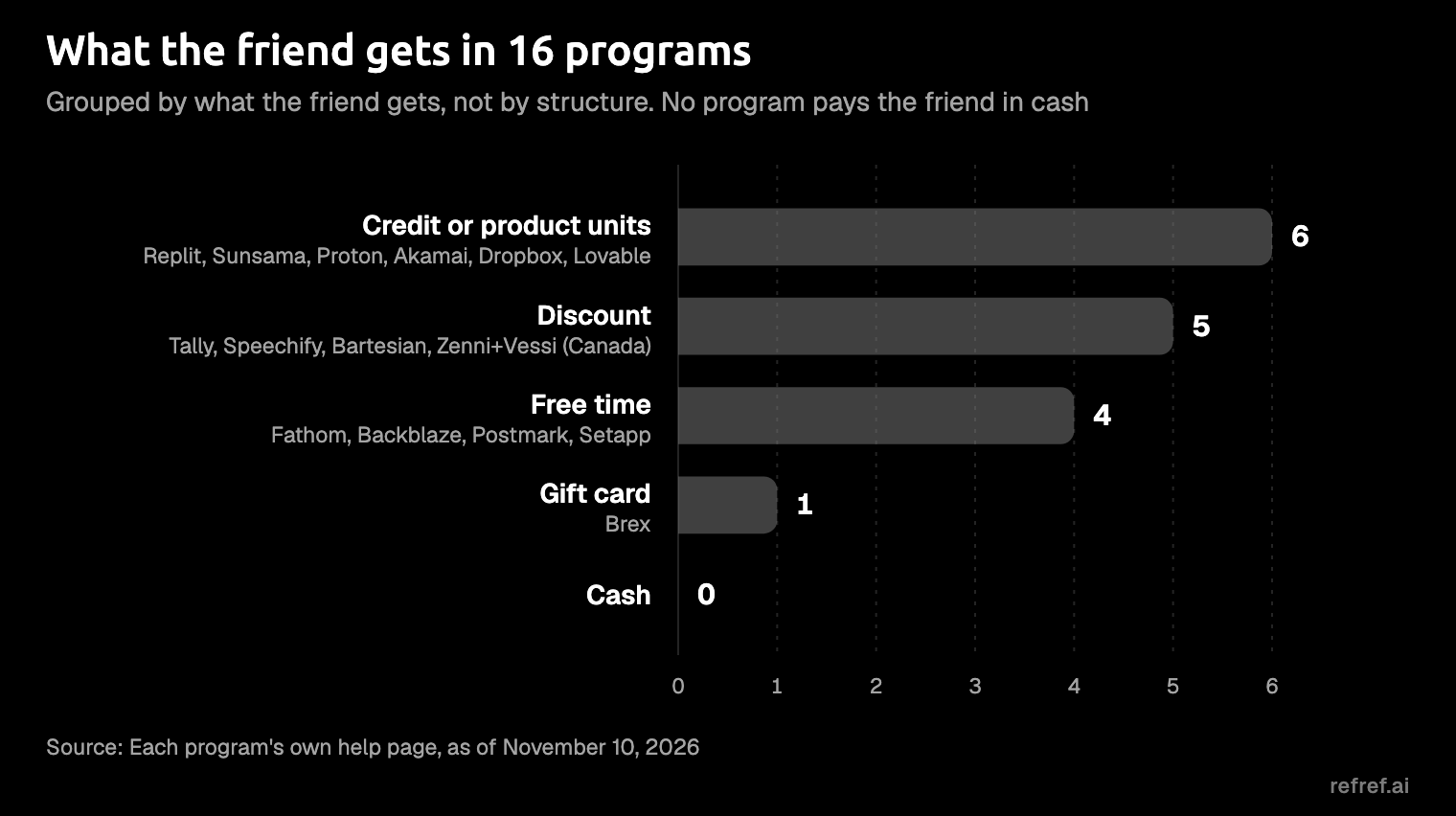
None of the sixteen pays the friend in cash. The closest is Brex's gift card, and the referred company has to spend $5,000 in its first month, or run payroll through Brex, to earn it.
Most teams should start with the first two rows: a reward in the same currency as your product. It costs you margin rather than cash, and it can only be spent on the thing you sell.
1. Credit for credit
Both sides get account credit, applied to a future bill. It's the most common structure for subscription and usage-billed software, because the reward never leaves your billing system: you give up a slice of a future invoice instead of sending money out.
| Program | Referrer gets | Friend gets | When it pays | Cap on the page |
|---|---|---|---|---|
| Replit | $20 in credits | $20 in credits | When the friend becomes a new paying customer | None stated |
| Sunsama | $22 credit | $22 credit | Friend: at trial start, applied on upgrade. Referrer: when the friend upgrades | None stated |
| Proton | $20 in credits | $20 in credits (plus a two-week trial on some plans) | Referrer: after the friend's first full month (two on monthly plans) | $1,000 per referrer |
| Akamai Cloud | $25 non-expiring credit | $100 credit for 60 days | Friend: on adding a payment method. Referrer: after 90 days active and $25 spent | None stated |
Replit and Sunsama are the symmetric version, the same amount to each side. Sunsama pitches its $22 as one free month, which turns an abstract credit into something your customer can picture. Proton spells its guardrails out on the page. Its total referral credit stops at $1,000, or 50 successful referrals, and the credits can't be cashed out. If the friend cancels before the credit period ends, the referrer gets nothing.
Akamai Cloud's lopsided split is the honest version of this structure. The friend's $100 credit lasts 60 days, so it costs only what a new customer actually uses in those first weeks. The referrer's $25 never expires, but it waits for 90 days of activity and $25 of real spend. Akamai even asks referrers to have spent $25 themselves before they get a link.
A $100 credit that expires in 60 days is generous on the landing page and modest on the invoice.
If you bill monthly or by usage and your billing provider holds a customer balance, start here.
2. Product units: storage, credits, usage
Here the reward is more of the product itself: storage, AI credits or paid time. It works when your marginal unit is cheap to serve, because the friend gets a bigger taste of the product and the referrer gets more of what they already pay for.
| Program | Referrer gets | Friend gets | When it pays | Cap on the page |
|---|---|---|---|---|
| Dropbox | 500 MB per referral on Basic; 1 GB on Plus, Family or Professional | 500 MB extra storage | When the friend installs the app, logs in and verifies their email | 16 GB on Basic, 32 GB on paid plans |
| Lovable | 100 credits at the friend's first paid plan, then 25 per month paid | 10 credits at signup | Friend: signup. Referrer: first payment, then monthly | 400 credits; rewards expire 12 months after grant |
| Fathom | 30 extra days of Premium plus 100 points | A 60-day Premium trial instead of 30 days | Per successful referral | None stated; each link works once |
Dropbox is the program everyone means in the meeting, and it's stricter than you might remember. The friend has to install the app, log in and verify their email before either bonus completes. Team accounts can't send referrals, and people who already have a Dropbox account show as ineligible. The referrer's bonus also has a ceiling: 16 GB on Basic and 32 GB on paid plans.
Lovable shows how to reward a referrer over time without a lifetime promise. The referrer gets 100 credits when the friend first pays for a Pro or Business plan with at least 100 credits a month, then 25 for each month the friend pays, up to 400. If the friend prepays a year, all 400 arrive at once, and every grant expires 12 months after it's issued.
Fathom gives the friend a longer trial instead of a balance: their 30-day trial becomes a 60-day Premium trial. The referrer gets 30 extra days of Premium plus 100 points. Each link works once, and the referral has to come from a different company by email domain, which quietly ends the habit of referring your own work alias.
If your marginal unit is cheap, give units, not money.
3. Free months
Both sides get time: a free month of the plan they're on or about to start. It's the simplest offer you can say out loud, and it suits flat-priced subscriptions where a month has one obvious price.
| Program | Referrer gets | Friend gets | When it pays | Cap on the page |
|---|---|---|---|---|
| Backblaze | One free month | A free-month trial | Referrer: when the friend purchases | None stated |
| Postmark | A free month | A free month | Once Support verifies the referral | None stated |
| Setapp | One free month | One free month | When the friend starts a paid subscription | Invites not limited; not on Family or Setapp for Teams |
Backblaze and Setapp both wait for the friend to pay before the referrer's month arrives. Backblaze also requires the referrer to hold a paid license in good standing, and the friend has to install through the link. Setapp's page says outright that invites aren't limited, which most pages leave unsaid.
Postmark's whole referral flow is a support ticket. You email Support with the other account's address, and once it's verified, both paying accounts get a free month. It won't win a design award. It does prove you can run a double-sided referral program before you've built any of it.
Perplexity ran this structure for its Pro plan as "Give a month, Get a month," with 12 redemptions per link and rewards that didn't stack. That program ended on October 6, 2025, though existing referrals are still honored.
A free month is easy to explain and hard to value. Say what it's worth in your plan's price, as Sunsama does with its $22 credit, so your referrer knows what they're handing a friend.
4. Discount for credit or points (stores)
Stores usually split the two sides by kind: the friend gets money off a first order, often above a minimum, and the referrer gets store credit or points for next time. One app on the list, Speechify, uses the same shape with money off a subscription.
| Program | Referrer gets | Friend gets | When it pays | Cap on the page |
|---|---|---|---|---|
| Zenni Optical Canada | 300 Zenni Rewards points, worth CAD$15 | CAD$15 off a first purchase of CAD$75 or more | On the friend's qualifying first purchase | None stated; points expire 12 months after issue |
| Bartesian | 2,500 points | $25 off the first order | On the friend's first purchase; void if the order is canceled | No limit on referrals |
| Vessi Canada | A CAD$20 coupon | CAD$20 off a first purchase of CAD$100 or more | When the friend buys CAD$100 or more; valid one year, no stacking | None stated |
| Speechify | $60 off the next billing cycle; a free year of Premium after two or more referrals | $60 off Premium | After the friend subscribes | None stated |
Zenni and Vessi are their Canadian programs, priced in Canadian dollars.
An order minimum is the store's cap. Zenni's friend discount applies only to a first order of CAD$75 or more, and Vessi's only to CAD$100 or more, so the discount never lands on a tiny basket.
Points need a stated value. Zenni tells you its 300 points are worth CAD$15, while Bartesian's page gives 2,500 points per friend's first purchase and doesn't say what they're worth. If you pay in points, print the exchange rate next to them. Bartesian does void the reward when the friend's order is canceled, which is the store version of waiting out the refund window.
Vessi's codes don't stack, and that one line in the terms saves you a support thread with a customer who tries to combine the referral code with another code.
Speechify adds a milestone on top, which gives your best referrers a reason to keep going. Each side gets $60 off, and a referrer who brings in two or more friends gets a free year of Premium.
5. Cash or gift card for a discount
Here the referrer gets money, and the friend gets a discount or a matching gift card. Money and gift cards are the rewards most worth gaming, in our view, so both programs here put a firm cap or a high bar in front of them. It fits B2B products where one referred account is worth a lot to you.
| Program | Referrer gets | Friend gets | When it pays | Cap on the page |
|---|---|---|---|---|
| Tally | 20% of the friend's subscription payments, via PayPal or Venmo | 50% off for three months | As the referred user pays, once they upgrade | $150 per referred user; no limit on referrals |
| Brex | A $500 gift card | A $500 gift card | After the referred company spends $5,000 in its first month, or makes two payroll and two ACH payments in its first three months | Two gift cards per person |
Tally pays like an affiliate program with a friend discount attached. The referrer earns 20% of the friend's payments, up to $150 per referred user, and the friend gets 50% off for three months. Its rules ban self-referrals and paid ads on the link, the two ways a cash reward attracts people who aren't really recommending anything. If you pay cash, copy both rules.
Brex puts the bar where cash needs it. Both sides get a $500 gift card, but only after the referred company is approved and spends $5,000 on eligible purchases in its first month. The other route is two payroll and two ACH payments in its first three months, and each person can collect two gift cards at most.
Cash pulls in the wrong referrers unless your qualifying bar is high. Put cash on your link with no bar, and sooner or later someone will buy search ads on it.
Which structure fits your product
Start from how you bill, because the cheapest reward is the one your billing already knows how to deliver.
- Monthly or usage-billed SaaS with a customer balance: credit for credit. The reward is a smaller invoice.
- AI credits, storage or other metered units: product units. Give the friend a taste and the referrer more of what they already use.
- A flat-priced subscription: free months, with the month's price written next to the offer.
- A store with a typical basket: a first-order discount above a minimum for the friend, and credit or points for the referrer.
- High-value B2B: cash or a gift card for the referrer, behind a qualifying event only a real customer reaches.
Then bound the cost, and cap the referrer before the friend. The friend claims once. A keen referrer can claim all year.
Four levers keep the cost bounded, and most programs above pull at least one:
- Cap each side. Proton stops at $1,000 per referrer, Tally at $150 per referred user, and Brex at two gift cards per person.
- Prefer one-time or fixed-period rewards to lifetime ones. Lovable's monthly referrer credits stop at 400.
- Wait for payment. Sunsama, Backblaze and Setapp all hold the referrer's reward until the friend pays.
- Set an expiry. Lovable's credits and Zenni's points both expire after 12 months.
The amounts are a separate question, and it's a margin question. The reward-sizing guide works through it, and the referral reward calculator runs it on your own numbers.
How to set up a double-sided program in RefRef
RefRef publishes this blog, so read this section as the vendor's own walkthrough. Whatever tool you use, a double-sided program needs a reward for each side and a place to deliver each one. In RefRef, most of the structures above map straight to a reward type: account credit, discounts, or custom units such as free months, seats and plan upgrades. Credit, discounts and plan upgrades go out through your billing provider. Cash goes to referrers only, through PayPal or Stripe Connect payouts or on your own rail, and RefRef also offers gift card rewards through Tremendous.
- Create a referral program in
Programs, starting in the Sandbox Project so test referrals stay out of your live numbers. - Set the friend's reward. For the friend, use credit, discounts or custom units such as a free month, a seat or a plan upgrade.
- Set the referrer's reward from the same list, or pay cash.
- Choose whether each reward is one-time, fixed-period or lifetime.
- Add a stacking bonus rule if you want an extra reward on top of the main one, the job Speechify's free year does in its program.
- Set caps and allowances on each side.
- Connect your billing provider: Stripe, Paddle, Polar, Dodo Payments or RevenueCat. For a store, RefRef also has a Shopify app and a WooCommerce plugin. Neither store add-on is in its marketplace yet, so start from the Shopify or WooCommerce docs.
- Send a test referral through the Sandbox, check both rewards arrived, then set the program live.
Set the referrer's reward second. It's the one that needs a cap, and you'll size it better once you've decided what the friend gets.
A few details matter once real friends arrive. On Stripe, the Referral Widget shows the friend their discount code and applies it. A refund or lost dispute shrinks that purchase's rewards in proportion, and a full refund takes back a delivered non-cash reward, so the credit that went out the day before the refund doesn't stay out. For anything else, owners and admins can void a reward by hand, with a reason, and a void is final.
Credit, discounts and plan upgrades through your billing provider cost nothing extra on any plan, while managed cash payouts start on Starter and cost 2% of the amount paid out. There's a free plan for up to 1,000 monthly active participants, with no time limit, and paid plans start at $49 a month ($29 billed yearly). The double-sided program template has a placeholder for each side, so you can write the policy down before you click anything. Then the docs on programs and rewards show where each setting lives.
RefRef is open source under AGPLv3, with the code on GitHub. Use RefRef Cloud, or self-host it on your own servers with the docs. RefRef is younger than Dub or Rewardful and has a smaller community. You can read the code, try the free plan, and take your data with you if it doesn't fit.
Software that runs double-sided programs
Double-sided rewards are a standard feature, and you shouldn't pick a tool because it has them. Rewardful and GrowSurf both let you set each side's reward, with plans from $49 and $179 a month on their pricing pages as of November 10, 2026. ReferralCandy and Friendbuy list friend and referrer incentives separately too.
The feature is common; what you pay per referred order isn't. On top of a monthly fee from $39, ReferralCandy's plans add a share of each new customer's first three orders, from 10.5% on Basic to 1.5% on Scale and 0.25% on Enterprise. If you run a store, that share is the line to read twice, because it grows with every referral that works. A flat plan price doesn't notice how well your program does. A percentage does.
RefRef's difference is what it delivers and what it charges: credit, discounts and upgrades inside your billing provider, no share of referred revenue. Loyalty points and tiers run on the same platform, and it's the only open-source platform that runs referral, affiliate and loyalty programs together. The comparisons with Rewardful, GrowSurf, ReferralCandy and Friendbuy go feature by feature, and pricing has the plans.
Verdict and next step
Start with the structure that pays in your own currency, credit or product units, and copy its timing: the friend's reward early, the referrer's after the friend pays. Then cap the referrer side, because that's where the cost grows.
For building it, RefRef is our pick, with the disclosure above: credit, discounts and upgrades inside your billing provider, no share of referred revenue.
The quickest test costs nothing. Start free on RefRef Cloud, set up one program with both rewards in the Sandbox Project, and send yourself a test referral. You'll see each side's reward arrive before a real friend ever sees the link.